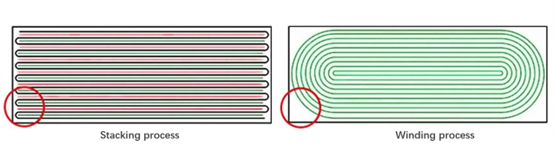
Process Principles: A Structural Comparison
The stacking process alternately layers pre-cut cathode sheets, separators, and anode sheets, stacking them flat and precisely aligned—much like the pages of a book—to form a neat, multilayer "layer-cake” structure.
The winding process, by contrast, stacks long strips of cathode, separator, and anode materials and winds them around a mandrel to form a cylindrical or oval "Swiss-roll” structure.
A Deeper Look at Consistency
The essence of cell consistency lies in the uniformity of internal stress, current paths, and thermal distribution—areas where the stacking process demonstrates clear advantages.
1. Mechanical stress uniformity
In stacked cells, electrode sheets are laid flat without bends or curvature. During charge and discharge, all layers expand and contract synchronously, distributing internal stress evenly. In wound cells, however, electrodes at curved sections are subjected to continuous mechanical stress. After repeated cycling, these areas are more prone to active material delamination and separator deformation. Test data show that after 1,000 cycles, the standard deviation of capacity fade in stacked cells is approximately 15% lower than that of wound cells, significantly reducing the "weakest-link” effect at the battery pack level.
2. Electrical path consistency
Stacked cells typically adopt a multi-tab parallel design, resulting in shorter and more uniform current paths. Their internal resistance is more than 10% lower than that of wound cells, enabling uniform reaction rates across the entire cell during charging and discharging. Wound cells often rely on a single-tab configuration with longer current paths and radial differences. Combined with the presence of a central hollow core and corner dead zones, this leads to lower space utilization and uneven electrochemical environments. Over time, disparities in capacity and internal resistance between inner and outer layers tend to widen, increasing the risk of performance divergence.
3. Thermal uniformity and safety
Stacked cells commonly employ multi-tab designs (such as full-tab or short-blade configurations), which distribute heat generation more evenly and provide more efficient heat dissipation paths. The layered structure allows heat to spread uniformly along planar directions. Wound cells, on the other hand, usually have only two tabs (one positive and one negative), resulting in long current collection paths. During fast charging, localized hot spots are more likely to form, compounded by heat accumulation around the central mandrel and temperature gradients between inner and outer layers. In simulated thermal runaway tests, stacked cells exhibited an average 27% longer heat diffusion time than wound cells, providing critical additional time for safety systems to respond.
Challenges Facing the Stacking Process
Despite its clear consistency advantages, the stacking process still faces two major challenges:
? Efficiency bottlenecks: Traditional stacking speeds are only about one-third of those achieved by winding. Although advanced "multi-sheet stacking” technologies have improved speeds to 0.125 s per sheet, the efficiency race continues.
? Cost pressure: Higher-precision equipment and more complex processes mean that stacked cell manufacturing costs remain approximately 5–8% higher than those of wound cells.
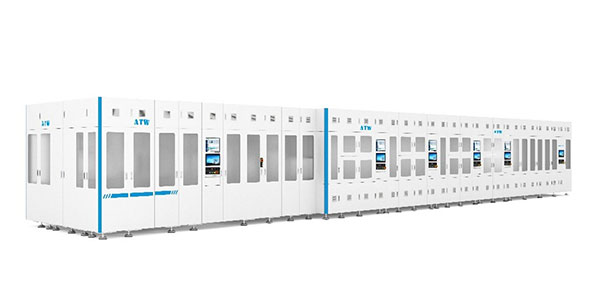
ATW’s High Speed Cut-Stack-Press Machine , featuring a proprietary innovative structural design, is equipped with high-precision control systems, advanced vision inspection, and real-time data monitoring. It achieves overall cell alignment accuracy of ≤ ±0.25 mm, a cell yield of ≥ 99.9% (excluding incoming material defects), stacking efficiency of ≤ 0.125 s/pcs, and an overall equipment efficiency exceeding 85%—effectively addressing the efficiency bottleneck of the stacking process.
Industry Trends: Accelerating Adoption of Stacking Technology
In recent years, advances in automation—such as Z-type stacking and thermal lamination stacking—have significantly improved the productivity of stacking processes. Many leading Chinese battery manufacturers are now deploying high-speed stacking production lines, particularly for LFP blade batteries and ternary pouch cells, where stacking is fully adopted to leverage its combined advantages in consistency, safety, and energy density.
Conclusion
Overall, the stacking process offers inherent advantages in cell consistency, making it particularly well-suited for applications with stringent requirements for performance and safety, such as electric vehicles and high-end energy storage systems. ATW continues to bridge the efficiency gap while strengthening precision advantages, driving the stacking process toward higher efficiency and lower cost. Looking ahead, as the lithium battery industry raises its standards for consistency, process upgrades and equipment innovation will become key competitive differentiators.
Contact ATW to join us in advancing the high-quality development of the lithium battery industry.

 English